
Solar Battery Storage& Retrofit Installationin Winchester & Hampshire
Keep the electricity your roof makes at midday and spend it at 6pm. New battery systems and retrofits to existing solar, fitted at 0% VAT, usually in a single day, with a fixed written quote typically within 48 hours.
25 years as a qualified electrician · MCS-qualified for solar PV and battery installation · NAPIT and RECC registered · 2-year workmanship guarantee.
25 years
Steve has worked as a qualified electrician for 25 years.
0% VAT
Battery storage installations currently carry 0% VAT, new build or retrofit.
Up to 30 years
Manufacturer warranties on supplied equipment, depending on brand.
One day on site
Most domestic battery installs are fitted and commissioned within a working day.
Storage is what turns solar generation into money you keep
A home battery stores electricity you have generated but do not need yet, then releases it when you do. Without storage, a solar array sends its surplus to the grid at export rates and you buy it back at retail rates a few hours later when the kettle, oven and TV all come on. Storage closes that gap, which is why most households see a bigger change in their bill from adding a battery than from adding two more panels.
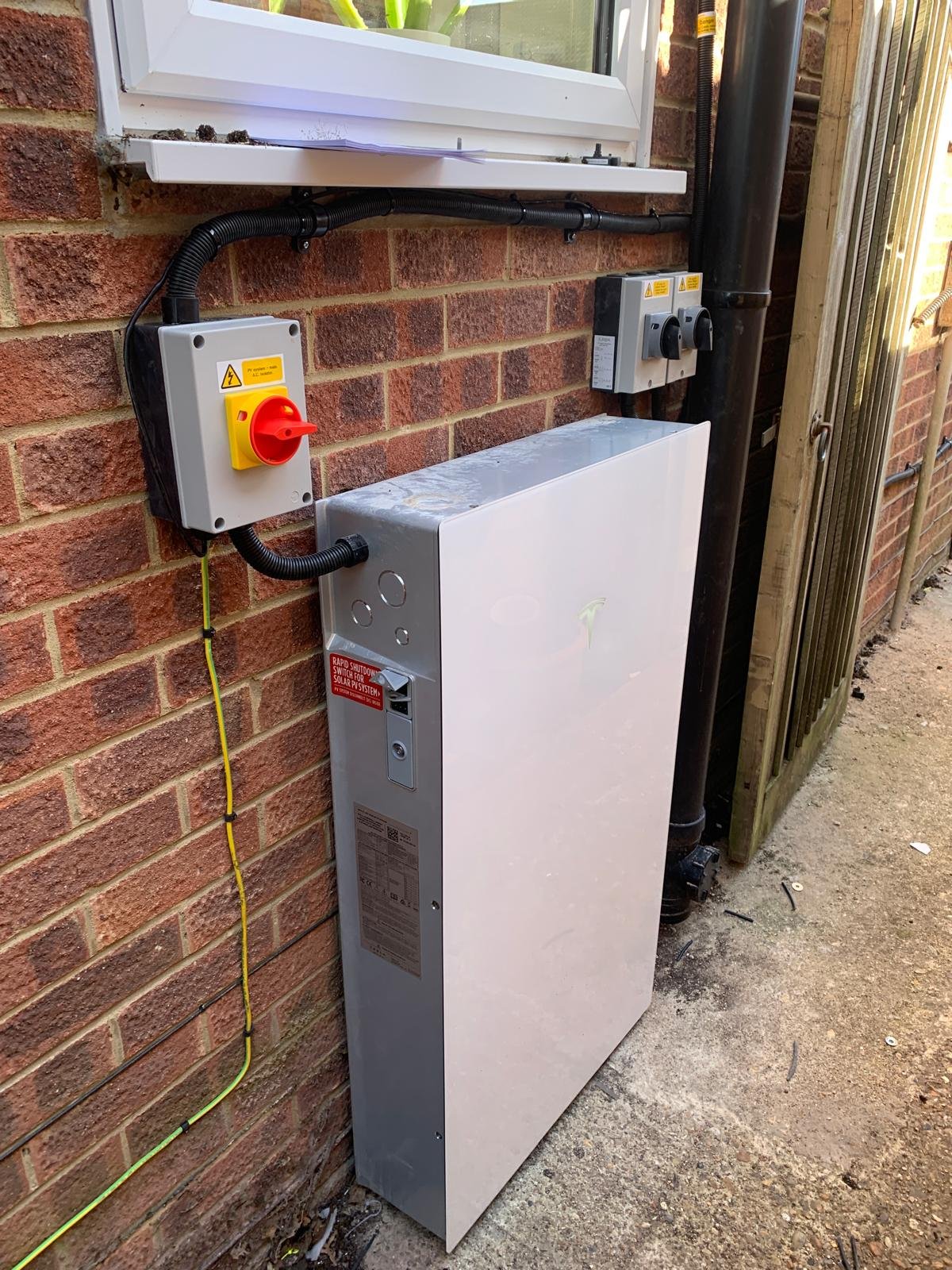
Selenium Energy installs new battery systems alongside solar and retrofits storage to arrays that are already on the roof: including systems installed by other companies. Steve is a qualified electrician of 25 years, MCS-qualified for solar PV and battery installation, with the company's MCS accreditation currently in progress. We are RECC registered and NAPIT registered under Part P, and every connection is certified to the 18th Edition of BS 7671.
The right capacity is decided by your evening consumption, not by the largest unit on the shelf. At survey we look at what the house uses after dark, whether an EV is charging overnight, whether you are on a time-of-use tariff, and how much room there is in the garage, utility or plant space for a wall-mounted or floor-standing unit with proper clearance and ventilation.
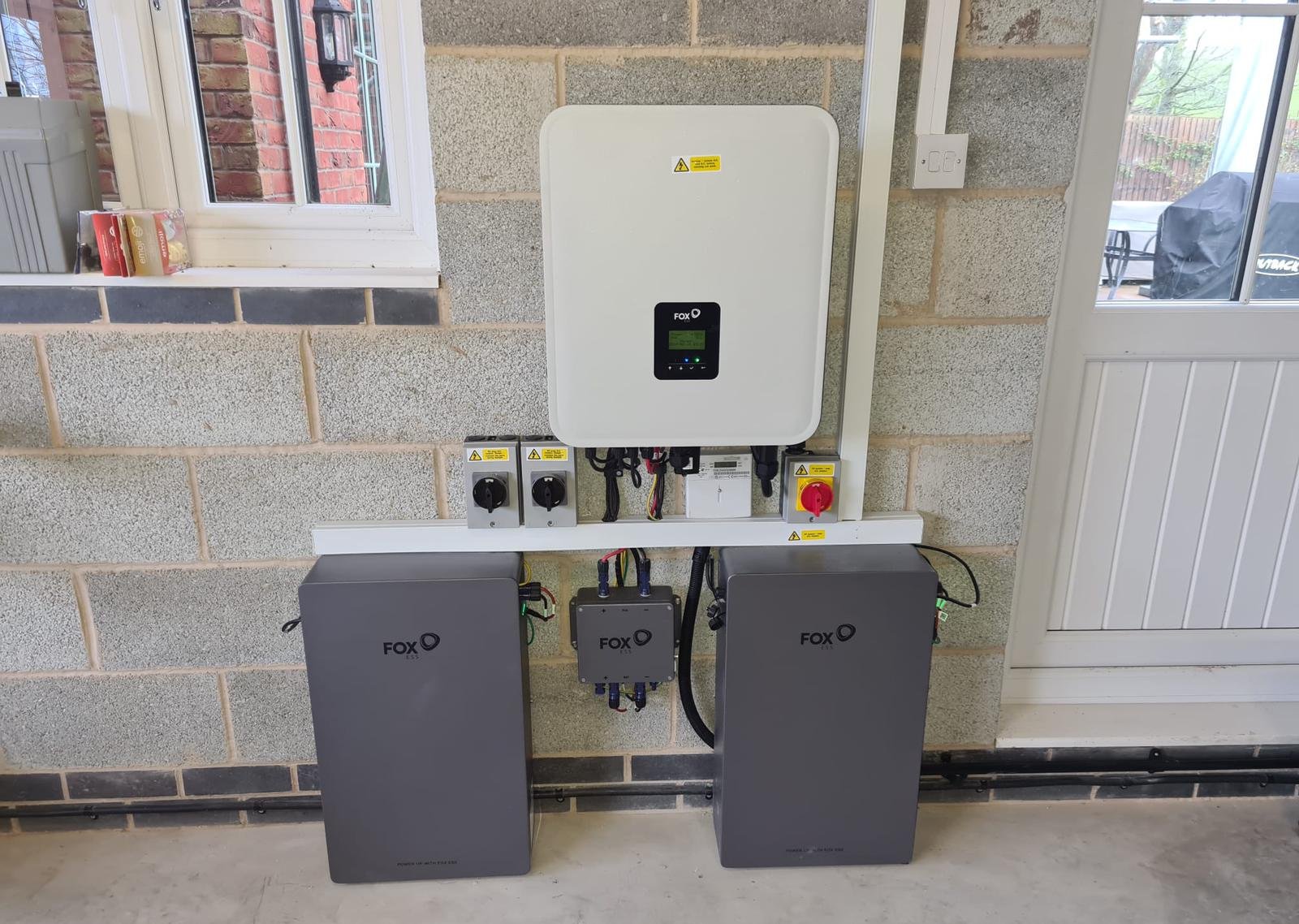
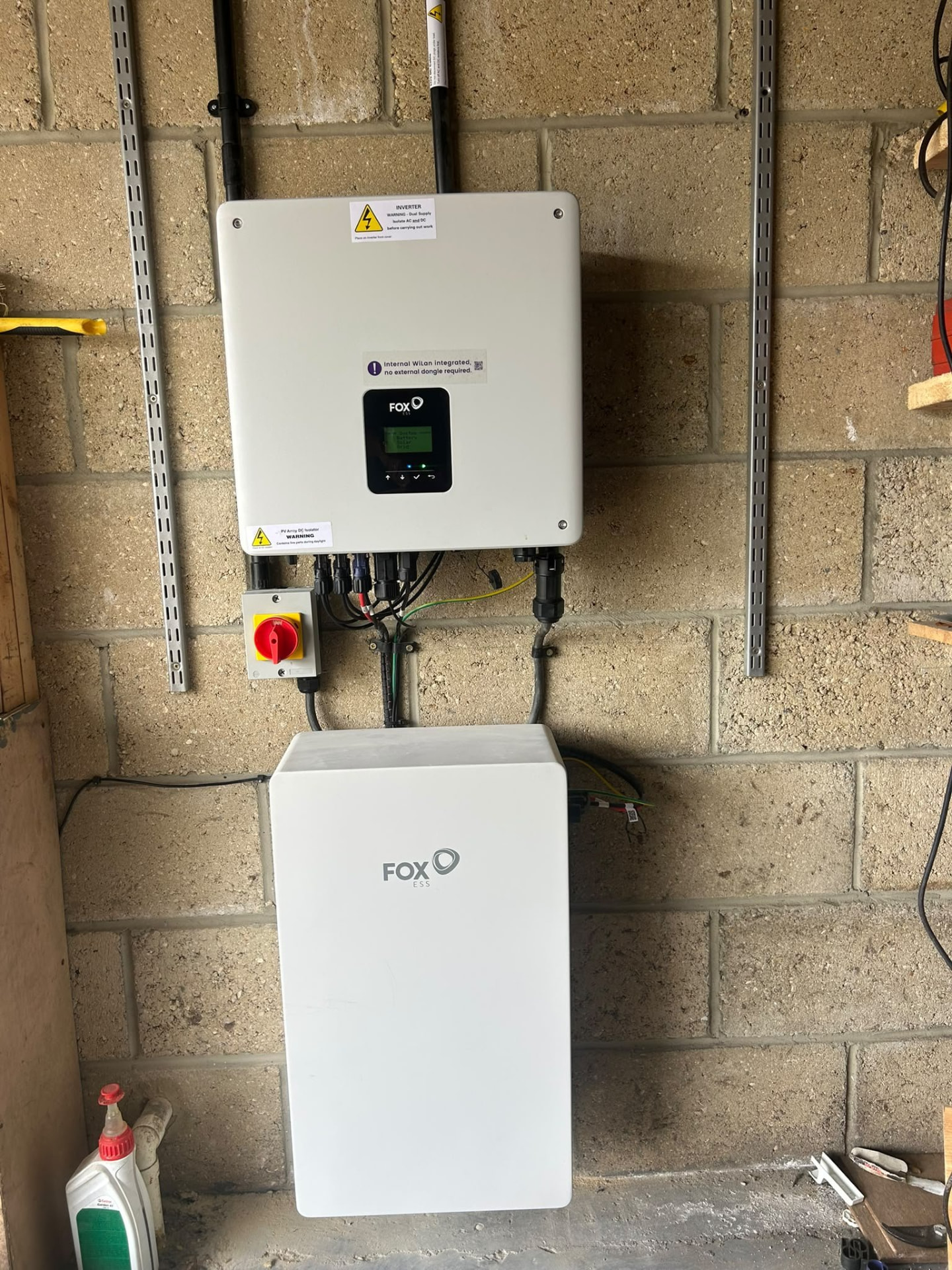
Recent installs show what real specifications cost: 10 panels with a Fox EP6 5.76kWh battery and inverter at £6,995, 13 panels with two Fox 5kW batteries at £8,500, and 12 panels with a Sigenergy 10kW battery and a 5kW inverter at £8,900. Battery-only retrofits are quoted individually against your existing inverter and board. A 25% deposit secures the date and the balance is due on completion.
Battery storage makes sense if
- You already have solar panels and watch generation exported at midday while you buy electricity at teatime.
- You are quoting solar now and want the system built battery-ready from day one.
- You are on, or could move to, a time-of-use tariff with a cheap overnight rate.
- You charge an electric car at home and want charging shifted onto stored or cheap-rate power.
- The house is empty during the working day, so almost all of your generation is currently exported.
- You want a degree of resilience through short power cuts on a system specified for backup.
What happens when storage is specified badly, or not at all
Batteries are the most expensive single item in most renewable installations, so the cost of getting them wrong is not a small one. These are the failures we are asked to put right.
You keep paying for your own electricity
With no storage, surplus generation leaves the house at export value and returns at retail price hours later. On a typical Hampshire household that gap is the difference between a good payback period and a disappointing one.
A battery too small to hold the evening
Undersized storage is empty by 8pm and the house switches back to grid import for the rest of the night. Oversized storage never cycles fully and you have paid for capacity that does nothing.
Inverter and board mismatches
A hybrid inverter with no headroom, or an old consumer unit with no spare way and no RCD protection, means the battery cannot be connected without further work: usually discovered on installation day if nobody surveyed properly.
Common mistakes with home batteries
- Buying capacity by headline kWh instead of by measured evening consumption.
- Installing a battery in an unventilated cupboard or a space with no safe working clearance.
- Assuming any battery will backup the whole house: backup requires specific equipment and wiring.
- Leaving tariff scheduling unset, so the battery never charges on the cheap overnight rate.
- Mixing incompatible inverter and battery brands and losing monitoring, control or warranty cover.
- Skipping certification on the electrical alterations, which causes problems at sale or landlord inspection.
How a battery installation runs, step by step
The same electrician surveys, installs, commissions and certifies the work, and answers the phone afterwards.
- 1
Free survey and inspection
We review your consumption pattern, existing solar and inverter, consumer unit, earthing arrangement and the proposed battery location, including ventilation and clearance.
- 2
Sizing and diagnosis
Capacity is matched to evening load and tariff. On retrofits we determine whether an AC-coupled battery or a hybrid inverter change is the better route, and quote both when it is close.
- 3
Fixed written quote
One written quote, typically within 48 hours: battery make, model and capacity, inverter, any board work, and the total at 0% VAT. No pressure, no chasing.
- 4
Installation, usually in a day
Battery mounted and secured, DC and AC connections made and labelled, isolators fitted, protection installed at the board, and the working area cleared before we leave.
- 5
Testing, commissioning and tariff setup
Full electrical testing to BS 7671, battery and inverter commissioning, charge and discharge windows set to your tariff, and app monitoring set up on your phone.
- 6
Certification and guarantee
Certification under NAPIT and Part P, manufacturer warranty documentation, and our 2-year workmanship guarantee. Balance due on completion.
What storage changes in the house
Evening power from daytime sun
Generation that would have been exported covers the cooking, lighting and TV peak instead: the period when electricity costs you most.
Cheap-rate charging
Charge windows are set to your tariff at commissioning, so the battery fills overnight at the low rate and carries the house through the expensive part of the day.
Bills you can verify
A recent Winchester install of 10 panels with a Fox EP6 5.76kWh battery came in at £6,995, with 0% VAT applied to the quote. Your own figures are worked out at the survey rather than promised up front.
0% VAT on the installation
Battery storage currently carries 0% VAT whether it goes in with new solar or as a retrofit, and that is applied to the quote from the start.
Safe, certified electrical work
Protection, isolation and labelling installed and tested to the 18th Edition of BS 7671, certified under NAPIT and Part P.
Equipment backed for the long term
Manufacturer warranties up to 30 years depending on brand, plus our own 2-year workmanship guarantee on the installation itself.
Battery storage in detail: equipment, coupling and siting
The technical decisions below are the ones that decide whether a battery performs for a decade or becomes an expensive ornament.
AC-coupled retrofit or hybrid inverter
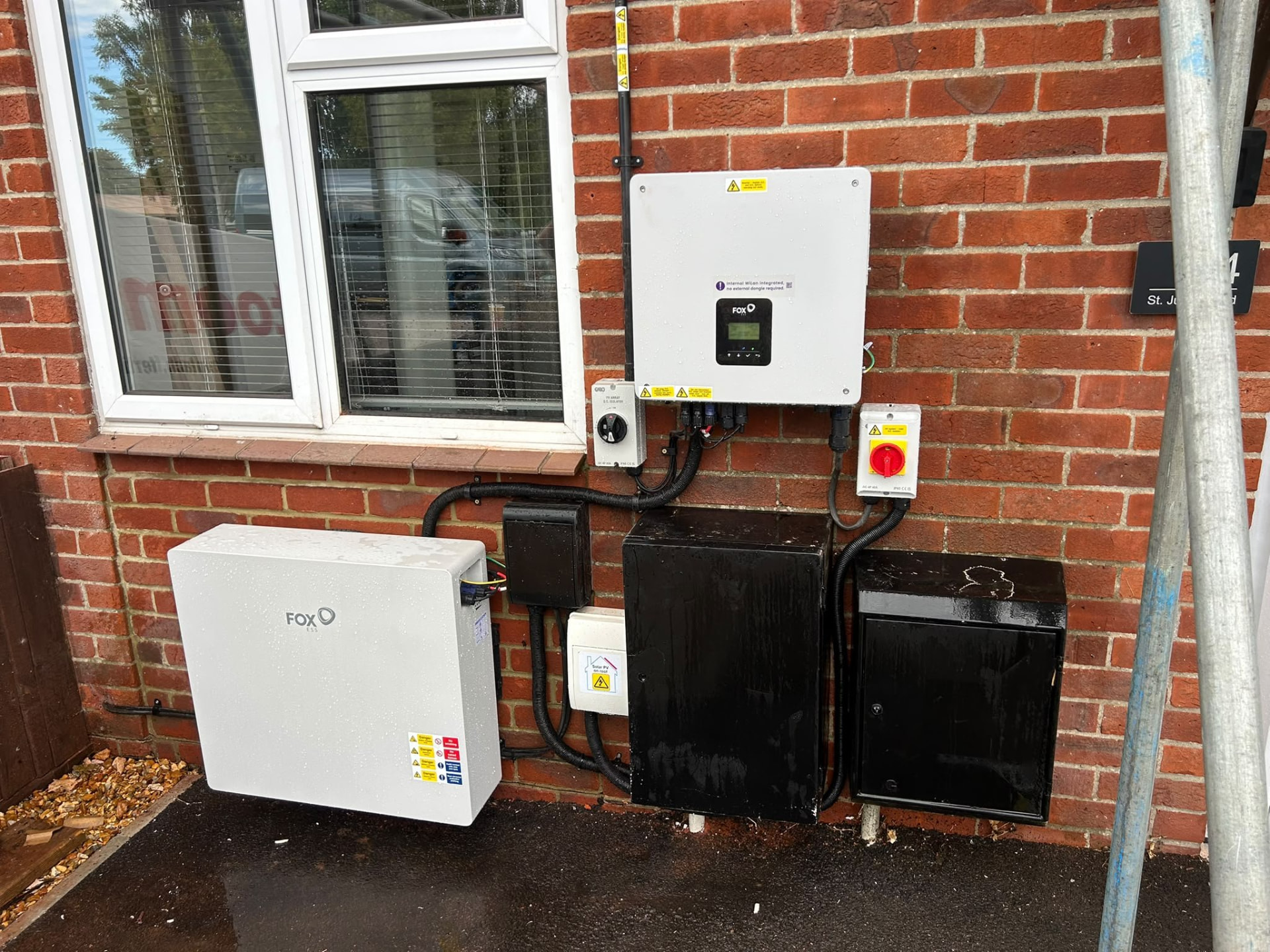
On a retrofit there are two routes. An AC-coupled battery has its own inverter and sits alongside your existing solar inverter, which leaves the original system untouched and is usually quicker and less disruptive. A hybrid inverter replaces your existing inverter with one that manages panels and battery together, which is more efficient and gives better control, but means changing working equipment.
Which is right depends on the age and condition of your current inverter, whether its warranty still has useful life, and how much capacity you eventually want. Where the decision is genuinely close we quote both so you can see the cost difference rather than take our word for it.
On new solar installations we fit a hybrid inverter sized for the battery capacity you may want later, not just the one you are buying now. That single decision is what makes a future upgrade a half-day job instead of an inverter replacement.
- AC-coupled retrofits to existing solar, including other installers' systems
- Hybrid inverter upgrades where efficiency and control justify the change
- Fox, Sigenergy and other established battery platforms
- Modular systems that accept additional capacity later
- Backup-capable configurations where resilience is a requirement
- Full labelling, isolation and protection to BS 7671
Sizing, cycles and lifespan
Useful capacity, not nameplate capacity, is what matters. Modern lithium iron phosphate batteries allow deep daily cycling and are warranted on a throughput or cycle basis, so a battery that cycles once a day within its rated depth of discharge behaves predictably over its warranted life.
We size around measured evening consumption, then check the array can realistically fill that capacity across the year. A 5kWh battery that fills and empties every day earns more than a 15kWh battery that half-fills: which is why the honest answer at survey is sometimes a smaller unit than you expected, with the option to add a module later.
Manufacturer warranties on supplied equipment run up to 30 years depending on brand and product; each warranty period is set out on your quote so you can compare like with like against other installers.
Where the battery goes, and why it matters
Batteries need a location with a stable temperature, ventilation, safe working clearance and sensible cable routes: garages, utility rooms, plant cupboards and outbuildings usually work well; sealed airing cupboards and loft spaces above habitable rooms usually do not. Wall-mounted units need a substrate that will carry the load, and floor-standing units need a level, dry base.
Cable route length affects both cost and losses, so the position of the battery, inverter and consumer unit relative to each other is part of the design rather than an afterthought. Where the consumer unit cannot accommodate the new circuits safely, we quote a board upgrade as a clearly separated line so you can see exactly what it adds.
- Garage, utility, plant room and outbuilding installations
- Consumer unit upgrades where the existing board cannot take the circuit
- EV charger integration for solar or cheap-rate car charging
- Energy monitoring so you can see charge, discharge and self-consumption
Domestic and commercial storage
Domestic storage is sized around the evening peak and a time-of-use tariff, and is usually installed and commissioned in a day. Commercial storage is sized around a business load profile and half-hourly data, where the value often comes from capacity charges and peak shaving rather than simple evening cover.
Workshops, offices and farm buildings frequently consume most of what they generate during trading hours, so storage is specified to catch weekend generation and to protect against expensive demand peaks. Three-phase supplies, metering arrangements and access planning around the working day are all handled in the quote.
Frequently asked questions
How much does a home battery cost in Winchester?
Storage is quoted individually because capacity, inverter and cable routes differ in every house. As a guide, recent complete installs include 10 panels with a Fox EP6 5.76kWh battery and inverter at £6,995, 13 panels with two Fox 5kW batteries at £8,500, and 12 panels with a Sigenergy 10kW battery and 5kW inverter at £8,900. Battery installations currently carry 0% VAT and the survey and quote are free.
Can I add a battery to solar panels I already have?
Yes: retrofits are a large part of what we do, including systems installed by other companies. At survey we check your existing inverter, consumer unit and earthing, then quote either an AC-coupled battery or a hybrid inverter change, whichever gives you the better result.
How long does installation take?
Most domestic battery installations are fitted, tested and commissioned within a single working day. Where a consumer unit upgrade is needed as well, we agree the additional time in advance rather than discovering it on the day.
How quickly will I get a quote?
The survey is free and your fixed written quote is typically with you within 48 hours. You deal directly with Steve, no salespeople and no follow-up pressure.
How long will a battery last?
Batteries are warranted by their manufacturers on a cycle or throughput basis, with warranties on supplied equipment running up to 30 years depending on the brand and product. Every relevant warranty period is written on your quote.
Will a battery keep my house running in a power cut?
Only if the system is specified for backup, which requires particular equipment and wiring rather than a setting. Tell us at survey that resilience matters and we will quote a backup-capable configuration and explain exactly which circuits it would hold.
Is the electrical work certified?
Yes. All work is certified to the 18th Edition of BS 7671 under NAPIT and Part P, and you receive the certification with your handover documents.
What guarantee do I get?
Two years on all workmanship, on top of manufacturer warranties on the equipment supplied: up to 30 years depending on brand.
How does payment work?
A 25% deposit secures your installation date and the balance is due on completion, once the system is commissioned and you are happy with it.
Do you cover my area?
We are based in Winchester and work across Hampshire, including Basingstoke, Southampton, Andover, Portsmouth, Salisbury, Reading and Oxford. Online enquiries are taken 24/7 and emergency call-outs are available outside standard hours.
Related services
Next step
Start on the home page, see finished installs on our work, or send your details through the contact page.
Find out what storage would actually save you
Free survey, honest sizing, 0% VAT and a fixed written quote usually within 48 hours. Send your details and Steve will call you back.
Steve Higgins · NAPIT registered · OZEV authorised · 2-year workmanship guarantee · Enquire online 24/7 · On site 7am–6pm